 TRAINING
20 May 2026→23 May 2026
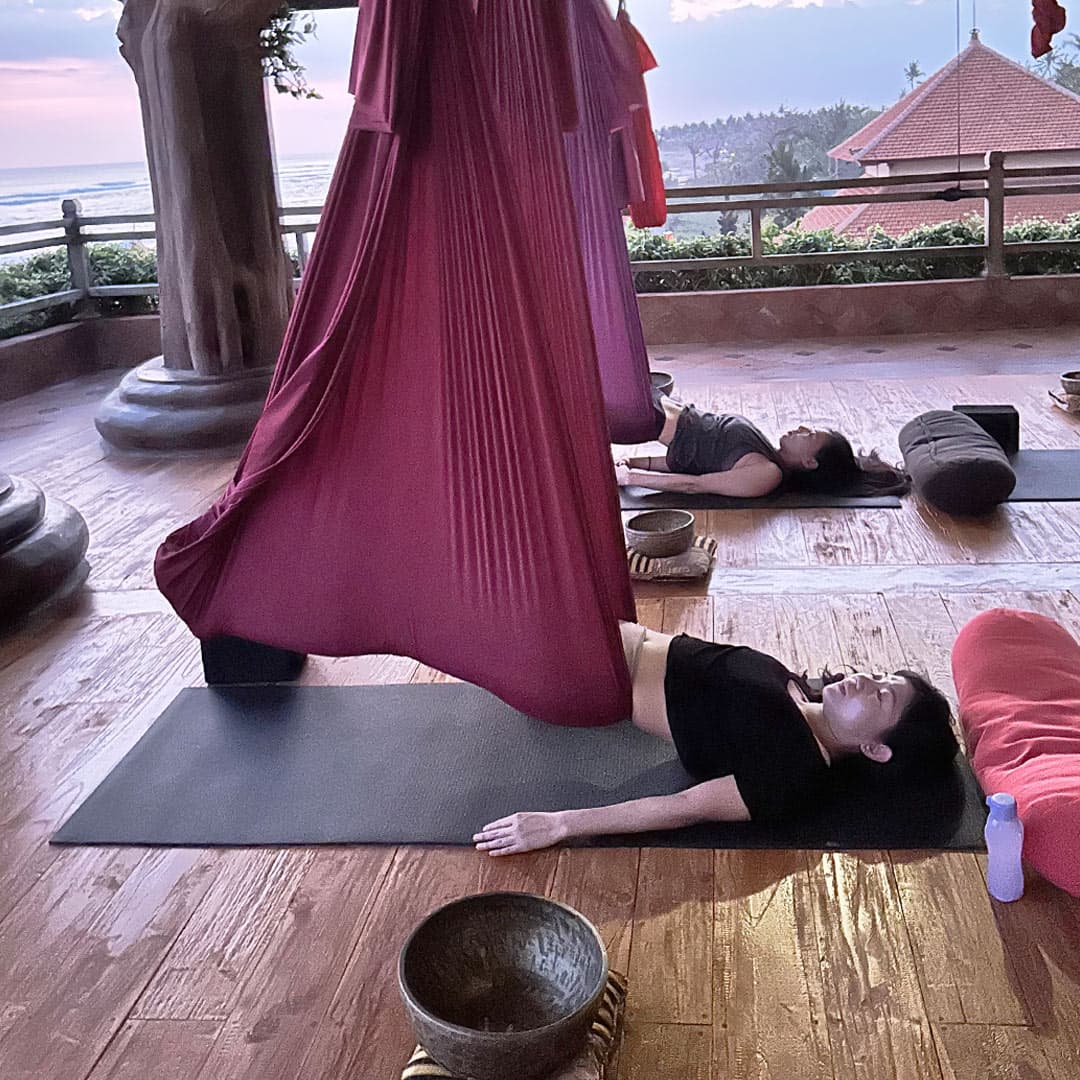
Aerial Yin & Restorative Teacher Training 25 Hours
Deepen your aerial practice with a specialized 25-hour Aerial Yin & Restorative Teacher Training, Ma...
Seseh, Bali
Have a yoga studio, event, or teacher training? Add it to FindYoga →
TRAININGDeepen your aerial practice with a specialized 25-hour Aerial Yin & Restorative Teacher Training, Ma...
Seseh, Bali
 RETREAT
The Sacred Reconnection Retreat in May invites you to rebuild your relationship with yourself, other...
Sukawati, Bali
RETREAT"The Sacred Reconnection Retreat" on May 21, 2026, guides you back to what matters most—your deepest...
Sukawati, Bali
 RETREAT
A shorter sacred song experience, this five-day retreat with Michele (May 21-26, 2026) at Finca Mia ...
 WORKSHOP
Immerse yourself in an evening of deep relaxation and holistic healing at the Divine Goddess Sound B...
Cherrybrook, NSW
 RETREAT
A weekend shaking retreat in the peaceful Costa Brava setting of Casa Santa Elena in Solius, Spain (...
Solius, Catalonia
Anusara yoga is a heart-centered practice that blends the precision of alignment-based yoga with an uplifting philosophy rooted in Tantric wisdom. Known for its joyful, celebratory spirit, Anusara invites practitioners to move not just with physical awareness but with an open heart and a sense of inner freedom. Students are drawn to it because it feels both technically grounding and spiritually expansive — a rare combination that makes each class feel like a genuine exploration of what the body and soul are capable of together. Anusara was founded in 1997 by John Friend, an American yoga teacher who had trained extensively in the Iyengar tradition. Friend developed a unique system he called the Universal Principles of Alignment, a set of biomechanical guidelines designed to help practitioners move safely and powerfully through postures while connecting to a deeper sense of purpose. The word "anusara" itself comes from Sanskrit and can be translated as "flowing with grace," "following the heart," or "moving in alignment with divine will." At its philosophical core, the practice draws from non-dual Tantric teachings, which hold that the body, mind, and world are fundamentally good and worthy of celebration rather than transcendence. Though the tradition experienced significant turbulence in the early 2010s following controversies surrounding Friend, many dedicated teachers have continued to carry its teachings forward with integrity and devotion. A typical Anusara class weaves together dynamic asana sequences, detailed alignment cues, and intentional themes that give each session a narrative arc. Teachers often open with a heartfelt intention or philosophical reflection before guiding students through warming poses, standing sequences, backbends, and cooling postures. The Universal Principles — which include concepts like muscle energy, organic energy, and the spiraling actions of the limbs — are woven throughout, offering students a consistent framework to refine and deepen their practice over time. The mental benefits are equally significant: practitioners frequently report increased self-confidence, emotional resilience, and a profound sense of inner ease that extends well beyond the mat. Because Anusara's alignment system is highly adaptable, it welcomes students of all levels, from curious beginners to seasoned practitioners seeking greater depth and meaning in their movement. It is particularly well suited for those who want yoga to feel not just like exercise but like a genuine practice of self-discovery. For anyone longing for a yoga experience that honors the body's intelligence while awakening the heart's deepest potential, Anusara offers a truly transformative path worth stepping onto.
Ashtanga yoga is one of the most dynamic and structured forms of yoga in the modern world, drawing practitioners who crave both physical challenge and deep inner transformation. Built around a precise sequence of postures linked by breath and movement, Ashtanga creates a moving meditation that simultaneously strengthens the body, steadies the mind, and ignites a profound sense of inner discipline. Its devoted following spans continents and generations, united by a shared appreciation for its rigor, its rhythm, and the quiet sense of mastery that comes from returning to the same sequence day after day, discovering something new each time. The roots of Ashtanga yoga trace back to Mysore, India, where the legendary teacher K. Pattabhi Jois developed and popularized the practice throughout the twentieth century. Drawing on ancient teachings and the guidance of his own guru, T. Krishnamacharya, Jois systematized the practice into fixed series of postures that progress in difficulty, beginning with the Primary Series, which focuses on purifying and aligning the body. Students traditionally learn at their own pace in what is known as the Mysore style, moving through the sequence independently while a teacher offers hands-on guidance and adjustments. This self-directed approach fosters a rare combination of personal accountability and communal energy that practitioners often describe as unlike anything else they have experienced on a mat. A typical Ashtanga session involves a set sequence of standing and seated postures, each held for five breaths and connected through flowing transitions called vinyasas. The consistent use of ujjayi breath, specific body locks known as bandhas, and focused gaze points called drishti create an internal heat that detoxifies the body and sharpens concentration. Regular practice builds remarkable strength, flexibility, and cardiovascular endurance, while also cultivating patience, focus, and emotional resilience. Because the sequences are fixed, practitioners develop an intimate relationship with their own progress over time, observing how the body and mind shift across weeks, months, and years. Ashtanga is particularly well suited to those who thrive with structure, enjoy athletic challenge, and are drawn to a practice with deep philosophical roots. Beginners are warmly welcomed, and teachers skilled in this tradition know how to meet students exactly where they are. For anyone ready to commit to a practice that will grow with them for a lifetime, Ashtanga yoga offers a path of extraordinary depth, beauty, and possibility.
Bikram yoga is a fiercely invigorating practice that takes place in a room heated to approximately 105 degrees Fahrenheit with 40 percent humidity, creating conditions designed to push the body to its outer edges while cultivating extraordinary inner focus. Practitioners move through a precise sequence of 26 postures and two breathing exercises over the course of 90 minutes, repeating each pose twice and following a strict, unwavering order every single class. There is something almost meditative about this rigid structure — regulars come to love it because progress is measurable, the ritual is familiar, and the heat strips away distraction in a way that few other practices can replicate. The sweat, the heat, the rhythm: for those who surrender to it, Bikram becomes deeply addictive. The practice was developed by Bikram Choudhury, an Indian-born yoga teacher who trained under Bishnu Ghosh in Calcutta and later brought his method to the United States in the 1970s. Choudhury designed the sequence to systematically work every muscle, joint, tendon, ligament, and organ in the body, drawing on traditional Hatha yoga postures and adapting them for maximum therapeutic effect. He believed the heat was essential, arguing that warm muscles stretch more safely and that elevated temperatures accelerate detoxification and cardiovascular benefit. The method grew rapidly through the 1970s and 1980s, attracting devoted followings across North America and eventually around the world. Though Choudhury himself became a deeply controversial figure, the practice he codified has endured and continues to be taught by thousands of independent instructors, often under the name hot yoga or the 26 and 2 method. The physical benefits of a consistent Bikram practice are considerable and well-documented by those who practice it. Students frequently report improved flexibility, greater muscular strength and tone, enhanced cardiovascular endurance, and meaningful relief from chronic pain conditions such as back pain and joint stiffness. The mental benefits are equally compelling — the concentrated heat and demanding sequence require a quality of presence that quiets the noise of daily life in a profound way. A single class leaves most people feeling simultaneously emptied out and deeply restored. Bikram is particularly well suited to those who thrive on structure and routine, competitive personalities who enjoy tracking tangible progress, and anyone drawn to physical challenge as a pathway to stillness. Beginners are warmly welcomed, as the fixed sequence means students always know what is coming next. For anyone ready to meet themselves at the intersection of heat, discipline, and breath, Bikram yoga offers a transformative and unforgettable journey.
Hatha yoga is one of the oldest and most foundational forms of yoga in existence, and for millions of practitioners around the world, it remains the perfect entry point into a lifelong practice. The word "hatha" comes from the Sanskrit roots "ha," meaning sun, and "tha," meaning moon — a poetic reminder that this practice is built on the principle of balance: strength and flexibility, effort and ease, body and breath moving in harmony. Unhurried and deeply intentional, Hatha offers something increasingly rare in modern life — a genuine invitation to slow down, tune in, and reconnect with the physical self in a meaningful way. The roots of Hatha yoga stretch back to medieval India, with the Hatha Yoga Pradipika, written by the sage Swatmarama in the 15th century, serving as one of its earliest and most revered texts. This classical manual outlined postures, breathwork, and purification practices designed to prepare the body and mind for deeper states of meditation. Over centuries, these teachings were carried forward by lineages of devoted teachers, and in the 20th century, pioneering figures like Tirumalai Krishnamacharya helped shape the modern understanding of Hatha as a systematic physical practice. Today, nearly every style of yoga practiced in the West — from Vinyasa to Iyengar — traces its roots back to Hatha's foundational principles. A typical Hatha class moves at a steady, accessible pace, guiding students through a series of standing, seated, and supine postures held long enough to cultivate both awareness and stability. Sessions almost always include focused breathwork, known as pranayama, and often close with a period of guided relaxation or meditation. The benefits are wide-ranging and well-documented: improved flexibility, greater core strength, reduced stress, better posture, and a calmer, more focused mind. Regular practice has also been linked to lower blood pressure, improved sleep quality, and a heightened sense of overall wellbeing. Hatha is particularly well suited to beginners, older adults, and anyone returning to movement after injury or a period of inactivity, though seasoned practitioners continue to find depth and challenge within its classical framework. Its emphasis on alignment, breath, and present-moment awareness makes it a grounding antidote to faster-paced styles, and its accessibility means that people of virtually every age and fitness level can step onto the mat with confidence. For anyone curious about yoga but unsure where to begin, Hatha is not just a starting point — it is a complete and luminous path in its own right, waiting to be explored.
Hot yoga is exactly what it sounds like — yoga practiced in a heated room — and for the millions of people who have tried it, the experience is nothing short of transformative. Typically performed in a studio warmed to anywhere between 85 and 105 degrees Fahrenheit with elevated humidity, hot yoga creates an intense, immersive environment that challenges the body and focuses the mind in ways that a standard room-temperature class simply cannot replicate. Students often describe the experience as equal parts demanding and euphoric, walking out of class feeling wrung out, deeply cleansed, and surprisingly clear-headed. The heat acts as both a physical intensifier and a mental crucible, stripping away distraction and inviting a rare quality of presence. The modern hot yoga movement owes much of its origins to Bikram Choudhury, who in the 1970s developed a structured 26-posture sequence designed to be practiced in a room heated to 105 degrees with 40 percent humidity. His method, known as Bikram yoga, brought international attention to the concept of heat-based practice and sparked widespread interest in the therapeutic potential of combining yoga with elevated temperatures. Over time, the broader term "hot yoga" evolved to encompass a range of styles and sequences practiced in heated environments, giving teachers and students more flexibility in how they engage with the format. Today, hot yoga classes can range from flowing vinyasa sequences to slower, more meditative practices — all unified by the signature warmth that defines the experience. The physical benefits of hot yoga are extensive and well-documented. The heat encourages muscles to loosen more readily, allowing for greater flexibility and a reduced risk of injury when practiced mindfully. Cardiovascular endurance, muscular strength, and balance all receive a meaningful workout during a typical 60 to 90 minute session. Sweating profusely also promotes a sense of detoxification, and many practitioners report improvements in skin clarity, stress levels, and sleep quality over time. Mentally, the challenge of staying present in a heated room builds focus and resilience that tends to carry over into everyday life. Hot yoga is particularly well-suited for those who enjoy athletic challenges, people seeking a meditative reset, and anyone drawn to the ritualistic intensity of a practice that demands full commitment. Beginners are absolutely welcome, though staying well-hydrated before and after class is strongly encouraged. For anyone ready to meet themselves with honesty, courage, and a little sweat, hot yoga offers one of the most rewarding journeys available on a yoga mat.
Iyengar yoga is a deeply intelligent and transformative practice that has earned a devoted global following for one simple reason: it works. Known for its extraordinary attention to alignment, its patient and methodical approach, and its masterful use of props, Iyengar yoga meets practitioners exactly where they are and steadily guides them toward greater strength, flexibility, and self-awareness. Whether someone steps onto the mat to recover from an injury, manage chronic pain, or simply deepen their understanding of the body, this practice has a remarkable way of delivering exactly what each person needs. The style was developed by Bellur Krishnamachar Sundararaja Iyengar — universally known as B.K.S. Iyengar — who was born in India in 1918 and went on to become one of the most influential yoga teachers the world has ever known. Introduced to yoga as a sickly teenager by his brother-in-law, the legendary T. Krishnamachar, Iyengar spent decades refining his understanding of the classical postures described in Patanjali's Yoga Sutras and developing a systematic approach to teaching them safely and precisely. His landmark book Light on Yoga, published in 1966, became a foundational text for yoga practitioners worldwide. Throughout his long life, Iyengar taught thousands of students and trained teachers who now carry his method across six continents. He passed away in 2014, leaving behind a legacy of unparalleled depth and rigor. A typical Iyengar session moves at a measured, deliberate pace, with teachers offering detailed verbal cues and hands-on adjustments to help students find the correct position of every limb, joint, and breath. Props such as blocks, belts, blankets, bolsters, and chairs are used not as shortcuts but as intelligent tools that allow practitioners of all abilities to access poses safely and experience their full benefits. This makes the practice exceptionally well suited to beginners, older adults, and those navigating physical limitations or recovering from injury — though seasoned practitioners continue to find profound challenge and discovery in even the most familiar postures. The benefits extend well beyond the physical: regular Iyengar practice cultivates concentration, mental clarity, and a quiet but powerful sense of inner presence. The nervous system settles, chronic tension releases, and practitioners often report feeling more grounded and more alive in their daily lives. For anyone who has ever wanted to truly understand their own body and unlock its remarkable potential, Iyengar yoga offers a lifelong path of discovery, precision, and grace.
Jivamukti yoga is a dynamic, spiritually rich practice that weaves together vigorous physical movement, devotional music, meditation, and ethical philosophy into a single, deeply transformative experience. Unlike styles that focus purely on the physical body, Jivamukti invites practitioners into a living relationship with the ancient teachings of yoga, making each class feel less like a workout and more like a journey toward genuine awakening. People are drawn to it precisely because it nourishes the whole person — body, mind, and spirit — leaving students feeling both energized and profoundly at peace long after they step off the mat. Jivamukti was founded in New York City in 1984 by Sharon Gannon and David Life, two artists and activists who had studied deeply with legendary teachers including Sri K. Pattabhi Jois, B.K.S. Iyengar, and Swami Nirmalananda. The name itself comes from the Sanskrit word "jivanmukta," meaning a soul liberated while still living in the body. Gannon and Life developed a method grounded in five central tenets: shastra (scriptural study), bhakti (devotion), ahimsa (nonviolence), nada (the transformative power of sound and music), and dhyana (meditation). These principles are not simply recited — they are woven into every sequence, playlist, and philosophical theme that teachers introduce each month through a shared "focus of the month" curriculum observed by certified instructors worldwide. The result is a school of yoga with remarkable consistency and depth, wherever in the world a student may practice it. A typical Jivamukti class moves through a flowing vinyasa sequence set to carefully curated music, ranging from chanting and kirtan to contemporary sounds, creating an atmosphere that is simultaneously invigorating and contemplative. Classes often open with the chanting of "Om" and a brief dharma talk rooted in yogic scripture, then build through sun salutations, standing postures, inversions, and deep stretches before settling into meditation and savasana. Students regularly report improvements in flexibility, strength, and cardiovascular endurance alongside meaningful shifts in mental clarity, emotional resilience, and a growing sense of compassion toward themselves and others. Because classes are offered at varying levels of intensity, Jivamukti welcomes curious beginners just as warmly as seasoned practitioners looking to deepen their understanding of yoga's broader philosophical tradition. Those who appreciate music, creativity, ethical inquiry, and a sense of community will find Jivamukti especially resonant. For anyone who has ever sensed that yoga could be something far greater than exercise alone, Jivamukti offers a beautifully lit path toward that larger possibility.
Kundalini yoga is unlike any other practice on the mat. Often described as the "yoga of awareness," it works simultaneously on the body, mind, and spirit, weaving together dynamic movement, breathwork, chanting, and meditation into a single transformative experience. Practitioners are drawn to Kundalini for its depth and immediacy — many report feeling noticeable shifts in energy and clarity after just a single class. Where some yoga styles focus primarily on physical postures, Kundalini reaches further, inviting students to awaken the dormant energy said to rest at the base of the spine and guide it upward through the body's energy centers. The result is a practice that feels both ancient and urgently relevant to modern life. Kundalini yoga as it is practiced in the West owes much of its form to Yogi Bhajan, the Sikh teacher who brought the tradition from India to the United States in 1969. Before his arrival, this technology had largely been kept secret, passed down only within closed lineages. Yogi Bhajan believed the teachings were too powerful and too needed to remain hidden, and he began sharing them openly, eventually founding the 3HO Foundation to spread the practice globally. The roots of Kundalini stretch back thousands of years through the tantric and Sikh traditions of northern India, carrying with it a philosophy that views every human being as already whole and infinitely capable. A typical Kundalini class follows a specific structure, beginning with a tuning-in chant, moving through a kriya — a set sequence of postures, breathwork, and focused intention — and closing with meditation and relaxation. Sessions often include repetitive movement, breath of fire, and mantra, all working in concert to stimulate the nervous system, balance the glands, and clear energetic blocks. The physical benefits include increased flexibility, core strength, and improved circulation, while the mental and emotional benefits can be profound: reduced anxiety, greater emotional resilience, sharper focus, and a deepened sense of inner peace. Kundalini is particularly well suited for those who feel drawn to a practice that goes beyond the physical, including beginners who may find highly athletic styles intimidating, as well as seasoned yogis seeking something that nourishes the soul as much as the body. No prior experience is required, only an open mind and a willingness to explore. For anyone ready to move beyond the surface and discover a practice that truly transforms from the inside out, Kundalini yoga offers a remarkable and lasting path forward.
Explore yoga, retreats and teacher training around the world